1minute Projection Mapping in Miyazaki General Comments
2019.2.1
This year marks the 7th edition of this competition, which began in 2012, and we feel that the history of this event has continued to accumulate. First of all, I would like to thank all the creators who have contributed their works and entries. During the past seven years, the video and art industry, including projection mapping, has been changing dramatically. This is a big challenge for us as a convention. Projection mapping on architecture and these competitions are not so much about "innovation" as they are about pure "visual expression". Small-scale projection mapping is also called "micro mapping" in Europe and the U.S. In addition to the individuality and technology of visual expression, this type of projection mapping can be completed independently in terms of the object on which the images are reflected, the relationship with the viewer, and the method of staging the space, making it a large field for advanced expression and challenge. It is a field with a great potential for advanced expression and challenge. This is a bit of a digression, but if the expression techniques and their variations are meant as research to expand horizontally, it is also important to have depth in order to achieve completion and maturity. In the case of projection mapping on buildings, this is exactly what we are doing, and we are now in the maturing stage. In an international competition such as ours, it is necessary to have such a multifaceted vision for the future, and I believe that we have an obligation to present this vision in the content and results of our competition. We are very happy to see the number of entries, the attention and the emergence of newcomers and new faces as the level of this competition increases year by year, and all of us involved in organizing this event are very proud of that.
The Miyazaki Prefectural Art Museum, the venue and projection target of the 7th contest, has the simplest façade of all the buildings in the past contests, making it the most suitable for projection. The theme was "Myth/Legend," the most specific of all the past competitions. From this
Making the most of the architecture of the subject < Visual Expression
However, we wanted to see not only "3D expression," which has become a common form of projection mapping expression, but also softer and broader images and techniques. When considering new expressions and originality, it is impossible to move forward if we are bound by existing things, and sometimes we can update our expressions by breaking them down and moving in a different direction. For this project, we did not want to be too tied down to the "projection mapping expression," but rather hoped to expand the expression and beauty of the images. As a result, a rich variety of expressions emerged, and the competition was very stimulating and suggestive for the future. The theme of "Myth/Legend," which was chosen for this year's competition, has a figurative nature that has not been seen in the past, and it was necessary to firmly depict and convey the meaning of the work, which had been allowed to be ambiguous in some ways. In order to convey the main points of the competition, including these points, within a one-minute time frame, not only the appearance of the video, but also its composition and direction are very important.
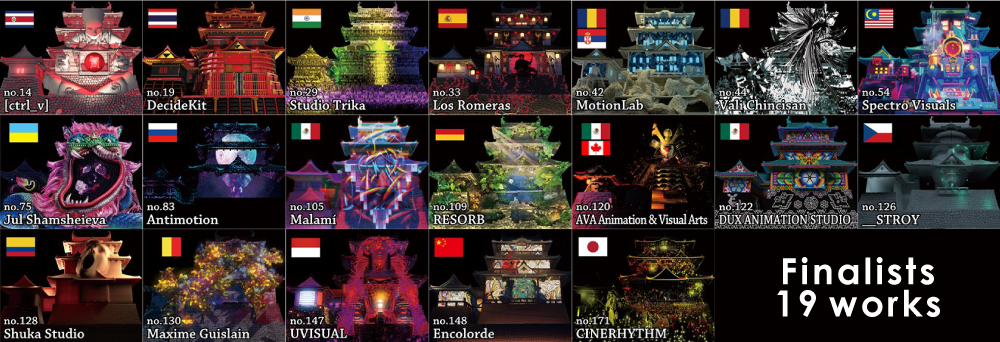
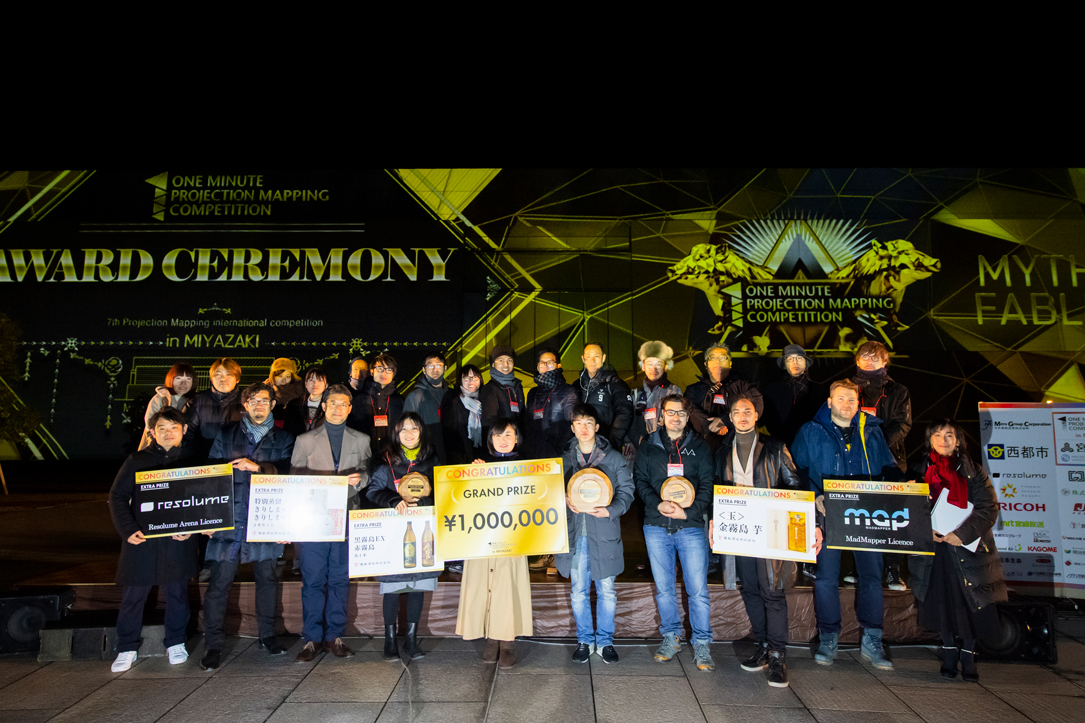
Out of 125 entries from a record number of 42 countries and regions, 19 works were selected as finalists for judging. The five judges, including myself, rigorously evaluated the entries based on the actual projection mapping on the buildings, and we are pleased to announce the results of the judging.
List of award-winning works] *"Title" team name (country)
Grand Prix: "The Nine Colored Deer" LiCheng (China)Runner-up Prize: "Ice Winter Sakura" ArtZebs Gallery (Ukraine)Special Jury Prize: "Stag" Fluid (Hungary)Miyazaki Prefecture Governor's Prize: " KAMISHIBAI" DECIDEKIT (Thailand)Audience Prize: "The Nine Colored Deer" LiCheng (China)Special Prize: "Chaos" High Files Visuals (Italy)Special Prize: "Quimera" AVA Animation & Visual Arts (Mexico)
Grand Prix "The Nine Colored Deer" LiCheng (China)
Click here for video⇒https://youtu.be/ra4VfNQFNbw
The winner of both the Grand Prix and the Audience Award this year was the work "The Nine Colored Deer" by Li Cheng of China. This work not only showed excellent video production techniques, but also presented a beautifully designed world full of emotion that moved people's hearts. Projection mapping is often considered to be about "surprising people," but this work, which carefully approached people's emotions, seems to be unprecedented and was highly evaluated by the jury. The high degree of perfection of this work, which made the audience want to watch it over and over again forever, was superb.
Second Prize "Ice Winter Sakura" ArtZebs Gallery, Ukraine
Click here for video⇒https://youtu.be/IL1WfL2yvD
The next runner-up, "Ice Winter Sakura" by ArtZebs Gallery, an up-and-coming artist from the Ukraine, won the Grand Prize, continuing the momentum of its advancement to the finalist category. Although thematically weak, the artist focused on the design aspects of the work while using a simple 3D expression, and created impressive scenes reminiscent of mythology in many places.
Special Jury Prize "Stag" Fluid (Hungary)
Click here for video⇒https://youtu.be/S7CCwdIkRKo
The third-place jury award went to "stag" by Hungarian artist Fluid. Although it was a 2D work and used only gold colors, it left a very strong impression with its rich sense of space and color.
Miyazaki Prefecture Governor's Prize "KAMISHIBAI" DECIDEKIT (Thailand)
Click here for video⇒https://youtu.be/D1S5QtPAPQc
The winner of the Miyazaki Prefecture Governor's Award was "Kamishibai" by DecideKit of Thailand, a work that was very popular with the audience for its clear and beautiful depiction of various myths from around the world. The work was not self-indulgent, but was created with the audience and Japan in mind, and it was an entertainment that the audience never got tired of.
Audience Award "The Nine Colored Deer" LiCheng (China)
Click here for video⇒https://youtu.be/ra4VfNQFNbw
The Audience Award was a double win for the Grand Prix, and although we will not discuss the content of the work, it is rare in recent years for the jury and audience evaluations to overlap, and that is how outstanding this work was.
The jury discussed the selection of the entries, and once again, the level of the entries was high, and there were many more that we would like to award. The jury decided to award prizes to two of the entries.
Special Prize "Chaos" High Files Visuals (Italy)
Click here for video⇒https://youtu.be/JXVUY2huJXg
First was "chaos" by High Files Visuals of Italy, a work in black and white but with a quality rarely seen before. The challenging and fresh quality of the work was highly acclaimed.
Special Prize "Quimera" AVA Animation & Visual Arts (Mexico)
Click here for video⇒https://youtu.be/KaSzxWi1ceY
The other entry was "Quimera" by AVA Animation and Visual Arts from Mexico, a regular participant in this competition. This beautiful 3DCG of a South American design is a work that combines beauty and strength in a memorable way, and was ranked high in the judging.
Although we only commented on the winning entries, there were many others that were excellent and we would have liked to have given awards to.
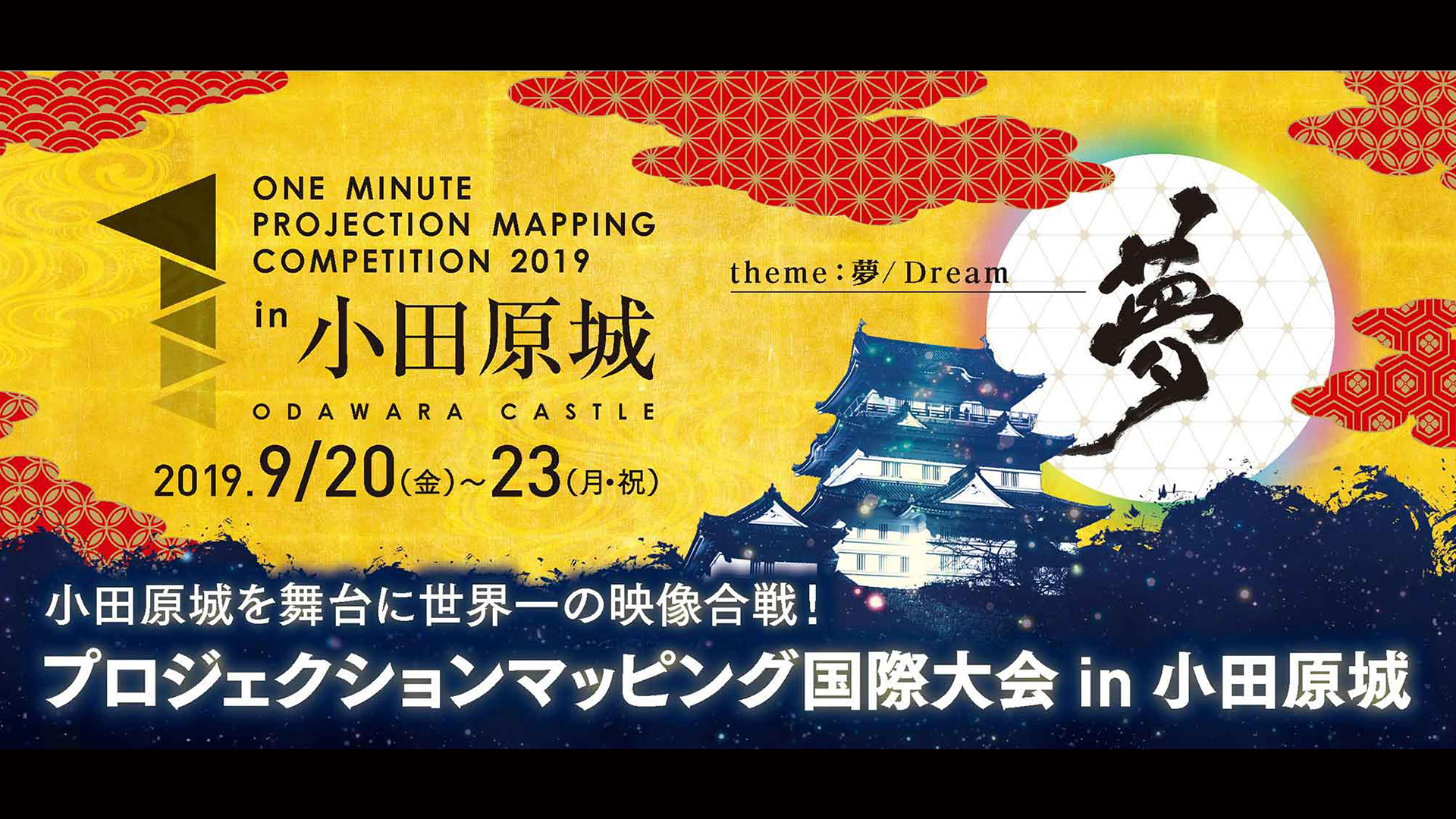
As we have already announced at the screening, the next 8th edition will be held in Odawara City, Kanagawa Prefecture. Odawara Castle, a symbol of Japanese architecture, will be the motif of the projection! The project is the most challenging one so far in terms of visual expression, and how to deal with the detailed and complicated architectural specifications of the Japanese roofs that are present? A simple video would not only fail to make the most of this structure, but would also result in a broken picture, so the approach to this problem is a major challenge and element of expression. It will require a completely different approach from the one taken in Miyazaki this time, and the ability and experience to imagine the design when architecture and images are combined will be tested. The opportunity to do projection mapping on a Japanese castle like this is truly a once in a lifetime opportunity, and we hope that many people will take up the challenge.
In particular, since there were no Japanese winners at the Miyazaki competition, we are very much looking forward to seeing a prize-winning entry from Japan at the Odawara competition.
Finally, we would like to express our gratitude to all the creators who participated in this year's event and hope that we can continue to work together to create a new page in projection mapping. Thank you very much.
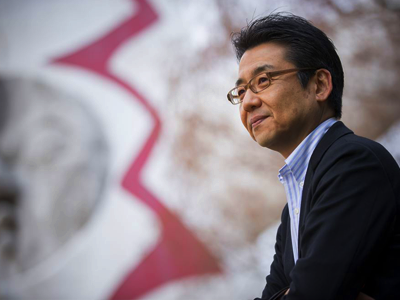
1minute Projection Mapping General Producer Michiyuki Ishida (PMAJ Representative)